Friday, 26 August 2011

Actual causes of death in the U.S.: not what you think

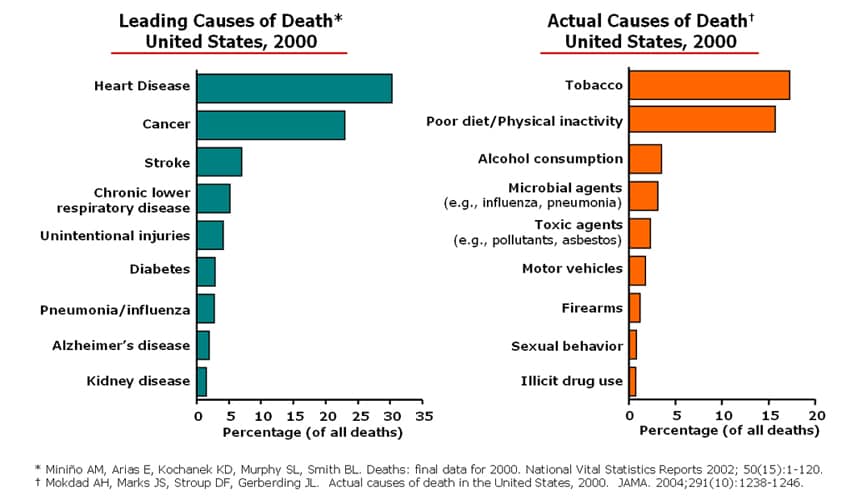
Any standard public health or medical school prevention text includes (or ought to include) some version of the figure below, which illustrates that the leading causes of death in the U.S. at the turn of the century (heart disease, cancer, stroke) were actually surrogates for what have come to be known as the actual causes of death: unhealthy behaviors such as tobacco use, poor diet, and physical inactivity.


The most effective preventive services that primary care clinicians provide, then, are not screening tests but counseling interventions that aim to change one or more of these behaviors for the better. Community-level initiatives such as tobacco-free restaurants and campuses, pedestrian-friendly cities, and increasing access to nutritious food sources play a critical role in changing health-related behaviors, too.


Unfortunately, the impact of behavioral or "lifestyle" approaches to prevention is likely to be limited by two factors: 1) even intensive interventions produce very modest benefits; and 2) behaviors don't exist in a vacuum, but are largely shaped by economic and social circumstances. Family medicine professor and former U.S. Preventive Services Task Force member Steven Woolf has published a number of studies showing that the risk of death is strongly associated with levels of college education and income; his research team at Virginia Commonwealth University worked with the Robert Wood Johnson Foundation to develop an interactive County Health Calculator that illustrates how many premature deaths could be avoided by eliminating educational and income disparities.


Researchers from Columbia University went a step further by publishing "Estimated Deaths Attributable to Social Factors in the United States" in this month's issue of the American Journal of Public Health. Using estimates derived from the literature on social determinants of health and year 2000 mortality data, they found that the "actual" causes of death looked like this:


1) Low education: 245,000
2) Racial segregation: 176,000
3) Low social support: 162,000
4) Individual-level poverty: 133,000
5) Income inequality: 119,000
6) Area-level poverty: 39,000


Clearly, we know a great deal more about successful strategies for fighting clinical and behavioral causes of death than we do about social causes, some of which often appear intractable. But I could not agree more with the authors' conclusion that "these findings argue for a broader public health conceptualization of the causes of mortality and an expansive policy approach that considers how social factors can be addressed to improve the health of populations." The point being: poverty, discrimination, and low education aren't just social or political issues best left to non-clinicians - they're health issues, too.

Thursday, 18 August 2011

Mammograms and death panels: why the Preventive Services Task Force keeps pulling its punches

Health reform was supposed to have been good news for the U.S. Preventive Services Task Force. Until 2009, this independent panel of federally-appointed experts in primary care and preventive health was not particularly well known, and its evaluations of the effectiveness of clinical preventive services had no binding authority on public or private insurance plans. Within the small circle of physicians and policymakers who were aware of the their work, however, the USPSTF won accolades and respect for "calling it as they saw it," sticking strictly to the evidence and writing screening recommendations that frequently conflicted with more expansive guidelines promulgated by other professional organizations.


For example, the USPSTF differed from the Centers for Disease Control and Prevention in finding insufficient evidence to screen for hepatitis C, and only recommending HIV screening in high-risk patients (rather than universal screening between the ages of 13 and 64). Unlike the American Diabetes Association, which endorses testing for diabetes in all patients age 45 or older, the USPSTF found that the evidence supported screening only patients with high blood pressure. The Task Force clashed with the American Academy of Opthalmology in finding insufficient evidence to support routinely screening adults for glaucoma. And it checked the pharmaceutical company-supported enthusiasm for COPD screening by concluding that there was no benefit to routine spirometry in adults without respiratory symptoms.


A more politically-minded group (as federally-supported guideline committees tend to be) would probably have been unable to make such a series of controversial statements without stirring up a public backlash. But here, the USPSTF's low profile served to protect it from the advocacy groups that dominate conversations about federal coverage for health care services. But in 2009, that all changed, as the Task Force was prominently featured in health reform legislation proposed in the U.S. House and the Senate. Ultimately, the Affordable Care Act mandated that USPSTF-endorsed ("A" and "B") preventive services receive first-dollar coverage from Medicare and private health insurance plans.


Scrutiny of the USPSTF quickly intensified, especially after it issued a politically-radioactive new statement that stepped back from recommending routine mammography for women in their 40s. It was tagged as a "death panel" that, in the words of one spectacularly misinformed newspaper columnist, had "gone rogue" and ought to be immediately dissolved. (Not coincidentally, there is a Roger Maris-sized asterisk in the ACA's list of USPSTF "A" and "B" services that basically directs insurers to disregard the USPSTF's 2009 breast cancer recommendations and instead rely on the 2002 version.) With the Task Force literally fighting for its very survival, it was perhaps inevitable that politics would begin trumping science - which goes a long way toward explaining why members were willing to meekly go along with the absurd cover story that their November 2010 meeting was cancelled due to "scheduling conflicts."


In the 17 months since the passage of health reform, the USPSTF has been only a shadow of its independent self. After publishing an average of one new statement per month for most of my tenure on their staff (2006-2010), a public comment process imposed by the Agency for Healthcare Research and Quality turned into a bottleneck for releasing timely, evidence-based recommendations. None of the 4 new statements that have successfully traversed the public comment process has been particularly noteworthy. Osteoporosis: a modest expansion of screening to more high-risk women under the age of 65. Testicular cancer: a reaffirmation of the near-universal consensus that screening is not necessary. Prevention of newborn gonorrhea eye infections: affirming the standard of care. And earlier this week, the USPSTF retreated from its previous recommendation against screening for bladder cancer was not warranted, instead finding insufficient evidence to make a statement one way or the other.


Of course, a Task Force that makes few waves is exactly what the current Administration wants. Never mind that clinicians and patients must continue to wait for long-overdue updates on screening for prostate cancer, screening for oral cancer, breast cancer chemoprevention, and vitamin D and calcium supplements. (All of these topics had already been voted by the Task Force and were within months of publication in March 2010 but have been subsequently delayed, postponed, or suppressed from entering the public comment queue.) How long can this state of affairs reasonably continue? As the 2012 elections draw nearer, how likely is it that the USPSTF will be permitted to advance any science with even remotely political implications? And - though it pains me to ask - is a Task Force that is forced to pull its punches due to politics really that much better than no Task Force at all?

Tuesday, 16 August 2011

Is climate change a clinical health issue?

At first glance, the topic of the cover article of American Family Physician's August 1st issue, "Slowing Global Warming: Benefits for Patients and the Planet," might seem out of place in a journal that aims to provide practical clinical guidance for family physicians. Past summer-themed articles have included reviews of heat-related illness, medical advice for commercial air travelers, and even health issues for surfers. By recognizing climate change as a clinical health issue, AFP joins other widely read medical journals such as The Lancet and BMJ in recognizing the essential role that physicians can play in mitigating the negative impacts of environmental stress on patients' health.


After summarizing the serious potential health effects of climate change, Dr. Cindy Parker recommends that primary care clinicians counsel patients regarding two lifestyle changes that are likely to improve personal health as well as slow global warming: reducing meat consumption and increasing "active transportation" (substituting bicycling or walking for short car trips). In addition, physician practices and larger medical organizations can positively affect climate change by "going green":


Medical offices and hospitals can help by recycling; using recycled items and Energy Star certified appliances and computers; minimizing waste and waste transport by replacing single-use items with sterilizable or washable items; purchasing wind-generated electricity; and reducing energy use by turning off appliances, computers, and lights when not in use. In 2008, the U.S. health care sector spent $8.8 billion on energy to meet patient needs, not including the transportation of employees or patients to and from health care facilities, resulting in 8 percent of all U.S. greenhouse gas emissions.


In an accompanying editorial, Dr. Robert Gould reviews several national and international initiatives that encourage hospitals and health systems to reduce greenhouse gas emissions, including the Healthier Hospitals Initiative and Health Care Without Harm.


**


The above post was originally published on the AFP Community Blog.